This is a blog of ongoing projects starting with: 1) Antarctica -Dec. 2006 - February 2007 2) Work made from the experience 2008 3) Nevada Feb. - Oct. 2008

Sunday, May 15, 2011

WAVE-PARTICLE

WAVE - PARTICLE, A PROPOSAL FOR A NEW WORK.


Drawings of the installation

One section through


The wave is an image I keep coming back to. Energy moves in the form of a wave, be it in weather systems, rivers, ocean currents, sound, and in our bodies. This wave energy is present in all matter, visible in the grain of wood, a nuclear explosion and the creation of the universe itself - within both microcosm and macrocosm.

Exploring these connections in 2009 I made a film, Breath, with Andy Mackinnon in North Uist, Scotland, which can be seen on the following link: http://vimeo.com/channels/taigh#14956047.


One idea had been to project the film onto Battersea Power Station or Tate Modern (itself a former power plant) during the Copenhagen climate summit .

With the proposed work Wave-Particle I would like to take this idea further. In quantum mechanics the theory of wave-particle duality states that all matter exhibits both wave and particle properties, but not at the same time. If you look at a particle you can’t determine its velocity and if you look at its velocity (i.e. the wave) you can’t see the particle, but they are in fact one and the same thing. This duality is central to the nature of matter; It is part of the nature of our lives.

The connection between the wave and nuclear power has been further illuminated by the events of this year – the tsunami in Japan and the nuclear meltdown at the Fukushima power plant. Waves are also of course at the heart of the physics of subatomic reactions and are currently being explored in the Large Hadron Collider experiment at CERN in Geneva.

The wave is therefore a very apposite image both of the ‘nature’ of matter itself and of what is happening in the world now. It is at once symbolic of man’s attempts to make sense of the complexities of the universe, of man’s exploitation of nature, and the potentially destructive power of nature itself. As well as the tsunami, the idea of the wave also alludes to global concerns about coastal erosion; it also contains prompts of nuclear tests in the Pacific, which have resulted in contamination of land and sea and the loss of livelihoods.

The wave then is both life and death.

Since 2008 I have been using particles (small units of substance) to create larger forms, most notably mushroom clouds, which have been linked into cycles of life, death and regeneration. The mushroom is the great symbol of this cycle as it breaks down dead matter into soil on which plants grow. Two recent works, Mushroom Cloud and Destroying Angel, are made respectively from dried mushroom slices and small bundles of sagebrush from the Nevada desert, strung floor-to-ceiling on nylon thread. There are obvious links in these pieces to nuclear testing, weapons, and the natural cycles of life and death. These works are constructed using a
schematic formula, illustrated below:

Destroying Angel - Nevada, 2008

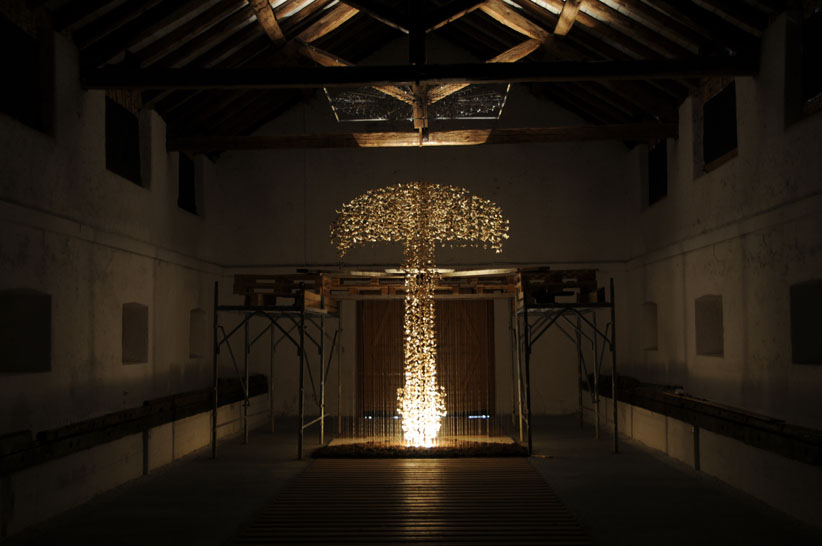
Mushroom Cloud - Arte Sella, Italy 2010

Drawings and plans for Mushroom Cloud

With all this in mind I would like to make a work that embodies both the life-death duality and wave-particle duality – a three-dimensional installation of a huge wave made from suspended fragments of detritus, both man-made and natural, washed up on beaches throughout the world. The work’s form would move from the relatively ordered vortex to chaos, giving the appearance of movement while remaining static, enabling the viewer to experience the duality the wave embodies.

The sculpture would be strung floor-to-ceiling on nylon thread, attached to hooks screwed into the ceiling or metal plates and would ideally be made to a height of at least 8 metres, though the dimensions would vary depending on the size of the space.

The material would be gathered principally from shores around the UK, so that it can be collected without resorting to air travel. I would do this myself but I would also like to involve people who live in coastal regions worldwide by asking communities, schools and other individuals to send me detritus by post. I would advertise the project by posting messages on my blog, on Twitter and Facebook, and contacting relevant organisations (such as the Coastal Communities Alliance in the UK and international conservation/environmental groups)
and newspapers such as The Guardian. My experience is that one of the most valuable things about making a new work is the process itself; simply making a work can change you and the people you work with. It creates a sense of community and generates discussion of ideas that often have a reach far wider than you’d originally imagined. That sense of engagement with the world is more important in some ways than the object itself.

An 8 metre-high work would probably take about three weeks to construct, and would require a small team of volunteer helpers.

This idea for a work has been entered for the Coal Prize 2012


Friday, February 25, 2011

Where humankind and nature converge

FROM THE GLOBAL EDITION OF THE NEW YORK TIMES FRIDAY, FEBRUARY 25, 2011 | 15

SPECIAL REPORT CONTEMPORARY ART

Where humankind and nature converge

LEWES, ENGLAND

A British land artist
explores the permanent
and the ephemeral


BY RODERICK CONWAY MORRIS

Visitors to the white chalk cliffs above this picture-postcard country town in southeast England will see a mysterious arabesque of ponds and reeds on the flood plain beyond the meandering River Ouse.

It was from this vantage point that, in the late 1990s, the artist Chris Drury first conceived of ‘‘Heart of Reeds,’’ a landscape sculpture covering four acres, or 1.6 hectares, whose graceful, looping, double-vortex forms are based on the blood-flow patterns of the human heart.

Chris Drury is now one of Britain's leading exponents of Land Art, a movement whose origins date from the 1960s and early 1970s in the United States, dedicated to creating works in natural, found materials, often in remote places.


As an expression of the themes that for nearly three decades have inspired Mr. Drury—nature and culture, the inner and the outer, microcosm and macrocosm—‘‘Heart of Reeds’’ is a characteristic piece. What makes it unusual is that it is so close to home. (Mr. Drury settled in Lewes with his family in 1982.) Most of the rest of the artist’s site-specific work has been carried out in places scattered around the globe, from Scandinavia, Greece, Spain and the Italian Alps to the Himalayas, Sri Lanka, Japan,Antarctica and the Nevada desert.


Works by ChriS Drury: ‘‘Heart of Reeds’’ (2005) in Lewes, England;


‘‘Wind Vortices’’ (2007) in Antarctica


‘‘Mushroom Cloud’’ (2010), made of dried mushrooms


Mr. Drury’s ‘‘Sky Mountain Chamber.’’

‘‘The land in this case was not wild nature but had just been reclaimed from old railway sidings and the town was trying to decide what to do with it,’’ Mr. Drury said on a recent crisp and sunny winter morning during a stroll along the paths that pleasantly wend their way through the reeds. ‘‘When I went to the local authorities with my idea, they were very dubious. But I did drawings of it and held a show of them, and the town approved.’’

It took five years to raise the £150,000
—which at the current exchange rate is $243,000—needed to carry out the project, which was completed in 2005. It is now a constantly changing spectacle, according to the seasons, a haven for warblers and kingfishers, loud with the croaking of frogs in summer.

Chris Drury was born the son of a tea broker in Colombo in 1948 and came to
Britain when he was 6 years old. He studied sculpture at Camberwell College of Arts in London, where he also received a rigorous training in drawing from the British painter Euan Uglow. ‘‘He was an incredibly demanding teacher,’’ Mr. Drury said. ‘‘He set very frustrating drawing challenges, but in the end you could see the point of them.’’

After graduating, the artist received a
steady series of commissions for portrait busts. ‘‘I had learned all the skills I needed at Camberwell,’’ he said. ‘‘When I began to shift my interest to creating land art, they were in some ways a burden. But the drawing skills are still very important in planning projects. In many ways my projects are drawings put into action. I don’t draw for its own sake, but to form, refine and execute works.’’

Mr. Drury’s transition from figurative artist to land artist began with a 12-day trek in the snowbound Canadian Rockies in 1974 with the land artist Hamish Fulton, who, along with Richard Long, was a pioneering British practitioner in the form.

Mr. Fulton records his journeys in various media but leaves no trace of his passing through the landscape. Mr. Drury, in contrast, began after that trip to work on ideas for creating sculptures at various selected sites along the paths of his journeys.

Mr. Drury has engaged only intermittently
with conventional private galleries through which he has sometimes sold his sculptures, paintings and photographs of his work in situ. Yet, he said, freedom from pressure to produce commercially saleable products in an easily recognizable style has left him free to engage with a vast range of collaborators, including craftsmen, astronomers, earth scientists, cardiologists, radiographers, town planners, architects and hi-tech experts.

He has also interacted with university communities, isolated farming villages and a Native American reservation — worlds that he finds much more ‘‘real,’’ he said, than what he sees as the overheated, ultimately claustrophobic contemporary art scene.

Mr. Drury has often spontaneously made works in wild areas of mountain, forest and desert. Others have beencommissioned by institutions and local authorities. These projects include designs for hospital grounds and parks. And more than a dozen public collections on both sides of the Atlantic now have works by him, including the British Museum and the Victoria and Albert Museum as well as galleries in Nashville, Tennessee; Raleigh, North Carolina; Reno, Nevada; and Seattle, Washington.

Unlike some of his fellow land artists, he has never been afraid to harness the latest technology. In 2006-7, the artist spent two months with British Antarctic Survey researchers on the ice cap. The experience gave rise to a typically varied group of works.

For ‘‘Wind Vortices,’’ he first made a drawing of the spiraling wind patterns passing over the ice, which he transferred to a map and replotted on a computer. He took advantage of a fresh fall of snow to trace out the wind pattern on the ice on a huge scale with a Ski-Doo snow vehicle, guided by a GPS device attached to the handlebars. He then climbed the neighboring mountainside to take a series of photographs of this
outsize drawing, which disappeared a few hours after he had taken them.


More permanent pieces were created from the patterns of echograms of the ice cap. Using a device that measures the layers of ice, each line on the echogram represents about 500 years of ice buildup. These reminded him of mountainous scenes in classical Chinese scroll painting, an effect he enhanced by highlighting them in pencil and ink. Other echograms were combined with strangely similar echocardiograms of the pilot who flew the Twin Otter plane low over the ice to take the soundings.

Shortly afterward, Mr. Drury went to investigate an extreme environment at the other end of the climate scale — the searingly hot region of the U.S. government’s Nevada Test Site, which covers 1,400 square miles, or 3,600 square kilometers, and was the scene of more than 900 atmospheric and underground explosions. The artist has long been fascinated by mushrooms, remarking that ‘‘a mushroom can feed you, kill you or cure you.’’ Imaginative works derived from them provided the leitmotif of an exhibition, ‘‘Mushroom/Clouds,’’ held at the Nevada Museum of Art in 2008.


At the same time, working with members of the local Native American Paiute people, who have been steadily deprived of their ancestral lands, he created installations in the desert, including ‘‘Winnemucca Whirlwind,’’ a design of concentric circles with diameters measuring 300 feet, or 90 meters, echoing the patterns (themselves taken from nature) used by indigenous basket weavers.


The building of symbolic shelters out of found materials — from stone, wood and mud to reeds, turf and ice blocks — were among Mr. Drury’s first land art constructions. They have since evolved into his ‘‘Cloud Chambers’’ series, or ‘‘camera obscura’’ works that reflect images of the surrounding landscape into the interior of the structure. These are now dotted around the world.

One, called ‘‘Star Chamber,’’ on a wooded hilltop at the Dyer Observatory near Nashville, demonstrates the phenomenon of the earth’s elliptical orbit around the sun. Another, on the shore of a reservoir in Northumberland in northern England, catches the movement of waves on the surface of the water through an angled periscope. Others still, in Japan, Belgium, Scotland and northern Italy, cast constantly changing pictures into their interiors of surrounding mountains, wind-rocked trees, sky and scudding clouds.

The ‘‘Cloud Chambers’’ are unusual in that, unlike many of the artist’s outdoor installations soon erased by the elements, these structures may last for many years. But they share with his more ephemeral pieces a common purpose. They are thoughtfully and skillfully composed, provide immediate aesthetic pleasure, evoke memories and almost dreamlike states and draw the viewer into the artist’s ceaseless search for elusive connections between mankind and nature. It is a quest that arises, in his words, ‘‘from a feeling of loss that is experienced by all modern technological societies.’’

Tuesday, February 01, 2011

ECO-ART - Pori Museum of Art, Finland


25th January - 4th February: Installation of 3 pieces at the Pori Museum of Art, Finland for the show ECO-ART, curated by John Grande, Peter Selz and Pia Hovi Assad.

The works are:

WIND VORTICES, Sky Blu, Antarctica 2007.
Printed by Elephant graphics in Sussex to a scale of 740 x 270 m.

DUST TO DUST, ASHES TO ASHES
-
A mushroom spore print painted directly onto the wall using dust from the ventilation ducts and ashes from birch logs used for heating a sauna.
Dimensions - 3 m. diam.


CARBON SINK
Made from birch logs, branches, twigs and charcoal sticks, the work is a vortex of logs laid on the floor 8 m. in diam.


On the first day the temperature outside was - 22
degrees and Errki and I headed out to a forest school 25 K. away to select the logs for Carbon Sink which were delivered later that day. Two of us, Veijo and myself laid the piece in 6 days. The print, in 10 sections, was hung by professionals and two artists painstakingly painted the spore print, which was projected on an overhead projector. It took them 4 days.


Artists in the show are:

Jan-Erik Andersson, Brandon Ballengee, Ciel Bergman, Christo and Jean-Claude, Joyce Cutler- Shaw, Agnes Denes, Chris Drury, Michael Flomen, Andy Goldsworthy, Helen and Newton Harrison, Ichi Ikeda, Richard Misrach, Nils-Udo, Dennis Oppenheim, Alan Sonfist.


It runs from 4th February to 29th May.

Tuesday, September 28, 2010

RHINE MOSEL SLATE WHIRLPOOL

This is a new work for Koblenz Garden Festival 2011.
Made from 20 Tons of slate on a site above where the Mosel flows into the Rhine, close to the Castle. The slate under the ground here is said to give the wine of the region its distinctive taste. The work was commisioned through the Heike Strellow gallery in Frankfurt and it is hoped it will remain as a permanent piece.


LAND, WATER AND LANGUAGE

4th September - 30th October 2010
Taigh Chearsabghagh Museum and Arts Centre, North Uist, Western Isles, Scotland HS6 5AA

I first visited these islands in the early 80s when I walked from The North of Lewis to Barra in the South. One of the abiding images I have from this walk was the sight of Eaval rearing up above the flat, flow country of North Uist, dominating the maze of Lochs and waterways. In 1997 I was invited to make a work around Lochmaddy and made the now much visited 'Hut of the Shadows'.


It was not until Andy Mackinnon mentioned the idea of a canoe journey through this land, that I was able to re visit this land and to finally climb Eaval and see it all spread out before me.


This exhibition is the first in a series about land and water which will be curated and devised by Chris Drury and Andy
Mackinnon at Taigh Chearsabhagh over the next 2 years. It is hoped that the ongoing project will involve, artists, writers,
film makers and musicians.
The project began in September 2009 when Drury and Andy Mackinnon (TC’s curator and filmmaker) made a two day
journey by Canadian canoe across the island, from the west coast back to Lochmaddy on the east coast, threading their
way through the maze of lochs and waterways. The result is this extensive show which includes the installation of a suspended
woven canoe, made from heather, willow and salmon skins, works on the wall using digital technology and place
names, with maps and satellite imagery; works with peat and water; a photogravure of the land traversed by canoe; and a
video of a breaking wave.

‘The Uists and Benbecula are part of a flow country whose interweaving of sea, lochs and land takes on a wave pattern, as
when the tide retreats from a beach. The chain of islands and sea are dominated by Eaval (Island Mountain) in the North
and Hekla in the South, both Norse names transfixing a fluid landscape with history and language. For the experience of
this land is multi layered: from the actuality of the place; the wind, the rain, the light, the sound of the curlew, the roar
of the surf, the brown squelch of the peat bogs and the scent of the burning peat from the cottage chimneys, intermingles
with the history interred in the place names on the map, given both in Gaelic and Norse: Encounter Loch, Secure Sheep
Island, Hillock of Many Priests, Loch of the Old Woman and something of the pain from the clearances: Isle of Lament,
Coffin Loch. So language and meaning and history are embedded in this now sparsely populated place. And using satellite
imagery we can look at this pattern of land and water observe the ever changing patterns of weather fronts which
mirror the land beneath. At the same time we can look at the microcosm in the small bacteria embedded in the peat bogs
and know through the science that these microorganisms are affecting the climate and the weather in which the whole is
embedded.’


Three Views of Eaval - peat on paper


23rd September 2009


Looking South From Eaval - Land and Language 1


Land and Water - photogravure


Land and Language 11


Detail


The Methane Eater - Life in the Field of Death - Methylocapsa acidiphila


Land Water Vessel - willow, hazel, heather and salmon skins


Monday, June 21, 2010

MUSHROOM CLOUD - ARTE SELLA MALGA COSTA

Mushroom Cloud – 9th - 22nd of June


The Sky Mountain chamber team are finishing clearing the outside of the building and plastering the inside for the screen which will take the image. They will also make the door. Meanwhile we start to think about the installation for the barn, which will be a mushroom cloud made from strung mushrooms with the video Way of the White Clouds projected up in a second floor area above the entrance.

I have drawn detailed plans of the pattern of the top and bottom, between which the nylon threads will be stretched. I realized when I was here last year that because this was an old milking parlor/cow barn it has a trench which runs down the entire length of the centre of the building which is now floored in wood. The floor can be removed, so you could in theory cut a hole in the middle, glaze it with acrylic and shine a light up through it, so lighting the work from one place underneath.

So working with Gabriele, the fixit employee of Arte Sella, and Emanuele’s brother in law, we start to set this up, and then after I have drawn out the bottom plan, Gabriele makes an identical pattern in welded steel for the top. Gabriele is a climber, so by means of ladders, scaffolding and a bit of ingenious rope work, Gabriele gets the top hanging in position. So we are now ready to start threading the 3000 pieces of mushroom – a variety of Cep bought commercially.

The plan is that the two women, Ivana and Annalisa, who come daily to clean and cook and who are also on a social scheme will help me with this. Ivana particularly is really looking forward to it. The stone guys would not be seen dead doing it. So we start in threading mushrooms. It soon becomes apparent however that this isn’t going to work. The air is very humid up here and the mushrooms soon become limp and slide down the threads. It is as I thought and I had warned Emanuele that we might have to dip them all in an acrylic sealer – he naturally was very against this, favoring ‘naturale’. So dip them all in sealer we did, but then of course the weather changed and it rained constantly so there was no sun to dry them. The solution was to light the woodburner in the farm house and dry them all overnight on racks. So it has been 12 days of stringing mushrooms and the work is almost complete; another day and we can take down the scaffolding. When we black out the interior and turn on the light the piece looks like a shower of gold – surprising even me.


Now, a day later it is finally complete


Friday, June 11, 2010

Arte Sella June 2010


Arte Sella 2010

I first came to Arte Sella to make a work in 1994, an image of that work will be in the Tate’s 2011 calendar. Arte Sella is a site specific Art and Nature organisation in the beautiful high Sella valley just south of the Dolomites, close to the town of Borgo Valsugana in the Italian Alpes. It was the brain child of an art teacher, an architect and a young artist who were on a trip to Samarkand in Uzbekistan. While standing in front of the tomb of Tamerlane they had the idea to create the conditions for a site specific art aligned to their own particular region of the world.

The organisation has gone through several incarnations and has now grown into an incredibly successful site specific contemporary art and music venue dedicated to Art and Nature and attracting up to 100,000 visitors a year. The extraordinarily beautiful forested valley with its flower meadows surrounded by limestone mountains is what really strikes you first about the place, and when walking the trail it is nature that is the dominant feature and the art is almost incidental, for the ethos here is that the art should be a part of this nature. It does however attract a huge number of people and it has to be said that its current incarnation is entirely down to the vision and drive of that one young artist – Emanuele Montibeller, who while running this amazing institution, only gave up his day job of selling fabric in the local markets, as recently as 2007. Arte Sella, has not only transformed the valley but it has benefited the local economy to a considerable extent. To read more about the place visit: http://www.artesella.it/eng.

Back in 1994 about 8 international artists were invited to come to Arte Sella and make something in return for hospitality, good food and wine, a catalogue and a traveling show of images of the work made, throughout Italy the following year + our expenses and what amounted to pocket money. We all stayed in the same house, had fun and got to know each other. The works we made were all temporary and have long gone. From this small gathering and through the other artists, I was later invited to make projects in Japan, America and Germany and was also instrumental in inviting some those artists to Britain. Now in 2010, the story is very different and I am here on my own staying in the Malga Costa, and being paid a fair fee for a large and permanent work.

The work I made in 1994 paid tribute to the mountain which dominates the valley and which is often invisible because of the thick forest. In this work called Tree Mountain Shelter, you entered a mountain shaped structure from which there was a view out through a narrow slit window, through the trees to the mountain wall. At the end of the project Patrick Dougherty and I climbed that mountain. On the invitation of Emanuele, I returned in 2008 to think about a new work, but strangely my first instinct to pay tribute to the mountain was still strong even though the site was different. I searched the area around the Malga for a site within trees, but with a view of the mountain. The only site where all the criterion were met was a amongst some dark pine trees adjacent to Guilliano Mauri’s Tree Cathedral.

I knew for a fact the when Mauri first made this, his last great work that he didn’t want any other work within a mile of it. The thing about Arte Sella however is that large egos have no place, works have to play second fiddle to nature and must rub along with each other. The Tree Cathedral is amazing and I have seen whole coach loads of Italian Catholics stand close to it and sing. The Pope has even expressed a wish to visit. In time however its only human connection will be the four straight rows of planted Beech trees; all the outer wood construction, enclosing the young trees will fall away and be forgotten. By placing a stone structure close by I will reconnect this Cathedral of beech trees back to the human impulse to create. My stone beehive structure will be a kind of ante Chapel or Rondello to the trees. The group of trees surrounding the work are in themselves, dark and enclosing, shielding the stone structure from the cathedral. A group of four of these trees is remarkable as one of the Fir trees is old, huge and gnarled and the three conifers entwine themselves around a single oak which spreads its lighter green leaves in amongst the darker pine needles.

So the idea which slowly evolved over 2008 – 9 was to make a cloud chamber which by means of an aperture angled at the mountain would project an image inside, of the mountain and sky, upside down. In time of course the tops of the trees of the Cathedral will become part of the image. The work would be made from the same limestone as the mountain itself. I was in two minds about the shape of the building – one part of me felt that a chapel like oratory would fit, but another part of me wanted the more archaic and mysterious beehive which would seem to fit the dark space within the fir trees. When I arrived in mid May I still hadn’t made up my mind, but the weather at the time was crystal clear and for the first time, just 30 m. from the site, looking North west was a clear view of the Brenta Dolomites. Their jagged snow covered spires echoed the conical shape of the structure I had in mind – so beehive it was.


I had estimated 150 tons of stone and asked for a team of skilled dry-stone wallers who could build such a corbelled structure. In the event no such expertise existed in the area. The valleys grow fruit and vegetables and there is no need for field enclosures in the high pastures – so there are no stone walls. Building with modern materials has done for any of the old building skills. Arte Sella however is a strongly socialist organization, taking into account the needs of the people of the area. No one gets paid huge sums including the artists and it works because it makes good use of what is available in the area. Within the local commune their exists a system of giving people who are out of work and approaching retirement a job in return for a living wage. It is a social system, and four of these men have the job of renovating the sculptures, making fences and generally taking care of the area around the Malga. One of these men was astonishingly the only guy in the whole region who knows how to build with dry-stone. My own ethos is also always to use what is locally available in both materials, labor and expertise.

I had expected, aged 62 to have the roll of director of works, but in the event I was the only one who knew how to make a corbelled building, and what we had in this instance was a ground plan where a rectangular interior is surrounded a circular exterior, so as we built up, the square walls would need to become a circular ceiling and that is not easy. On top of this I was told that the health and safety regulations for people on the social scheme stated that they could not work above 2 meters – and the building was going to be nearly 5 meters tall. Reno, the expert in dry-stone walling and the self appointed foreman, got round this by building an ingenious system of wooden scaffolding that satisfied his need for safety – up to 4 meters anyway. Plus it was a long way for any health and safety officials to come and inspect! In order to understand the exact shape of the structure we were building, he insisted on building a wooden structure which gave us a clear indication of the angle of the walls as we went up. It also meant I had to make up my mind and give precise measurements from the word go. Usually I work by eye and feel, but I realized that with his system I would get what I intended. This was particularly important as no one spoke English and I have virtually no Italian, so all communication was in sign language and by example.


So five old guys made this considerably large building in 3 weeks, with a week spent on the interior. One of the other guys turned out to have an eye and an enthusiasm for stone, so three of us were building and the two who stayed on the ground passed up materials, mixed up limestone mortar where it was needed etc. When we reached their limit in height I continued working and standing on the building. Stone was lifted to us by a series of machines which Emanuele had wangled off the commune for free. At one point we had a huge JCB with driver supplied by the Civil Defense. Since there had been no earthquakes or natural disasters the driver had time on his hands. He even mucked in and helped build. Limestone mortar, mostly for the stucco walls inside was supplied by a local firm for free. The Romans invented it and this particular company were experts and supplied the building industry for most of the country.

Unless a tree falls on it, this work is going to be around for a very long time and thousands of people will see it, go inside and see the mysterious image of the inverted mountain. I have a suspicion that Emanuele has an eye on it as his tomb!