This is a blog of ongoing projects starting with: 1) Antarctica -Dec. 2006 - February 2007 2) Work made from the experience 2008 3) Nevada Feb. - Oct. 2008

Friday, December 29, 2006

SKUAS


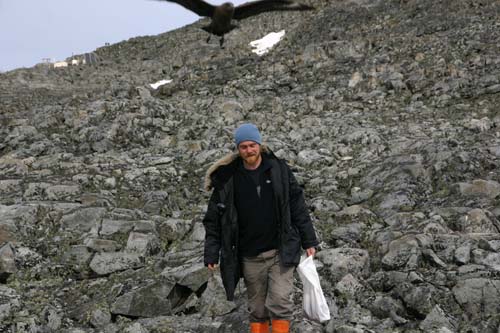
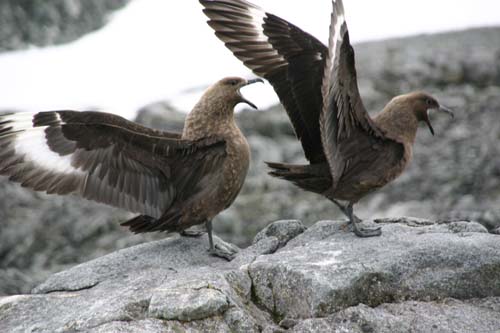
Otherwise known as bonxies are scarily large, and very aggressive when their nests are threatened, as we discovered when we headed up to the high point of Anchorage Island.
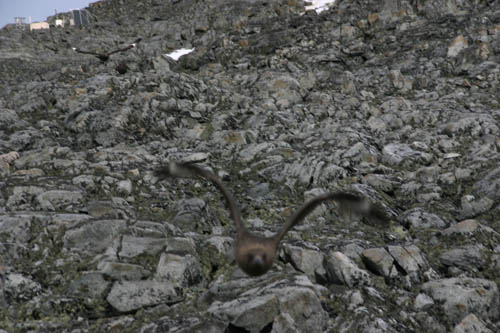
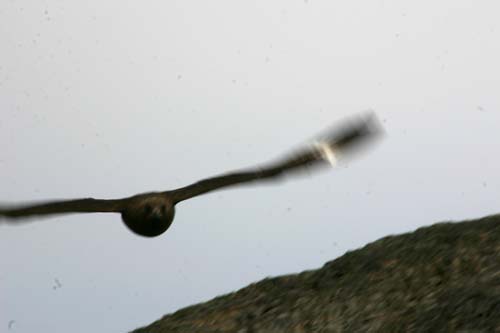
At this point the birds dive bombed us in earnest. At first there would be the swoop of wings just above the head, then they got bolder and we got whacked hard with their wings, and one point I was literally slapped across the face. Birds would come in low, aim at the head, bank and rise and come in again; several at a time and making a yowling noise like a dog.
In Scotland they tie a stick up above their heads and the birds go for that. A good idea because what we experienced was straight out of Hitchcock's 'The Birds'!

However it has to be said that a wing is a soft thing and it would have been worse to have been raked with beaks or feet. We survived and headed back to the boat with the prized shrimps. Then back across the bay for lunch. Minke whales were spotted off the peer not long after we landed.

FRIDAY 29TH. ANCHORAGE ISLAND


Fur seal


I am just considering what I might do today when I bump into Tim on the stairs. He asks me if I want to come out with him to Anchorage island - if so be ready to go in 10 minutes.

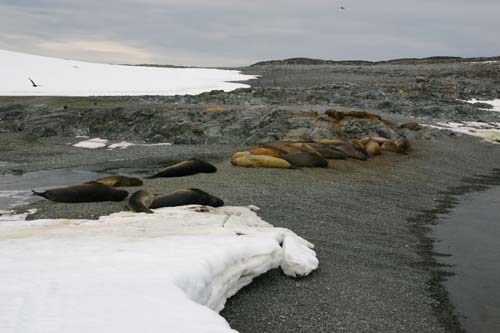
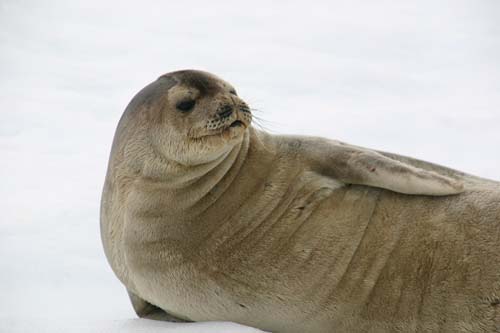
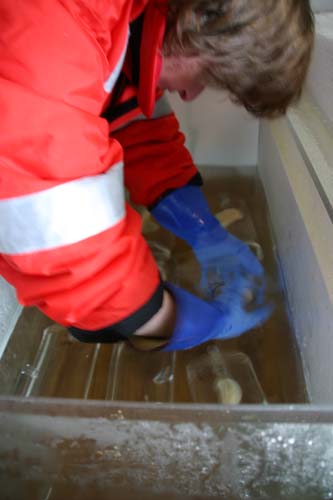
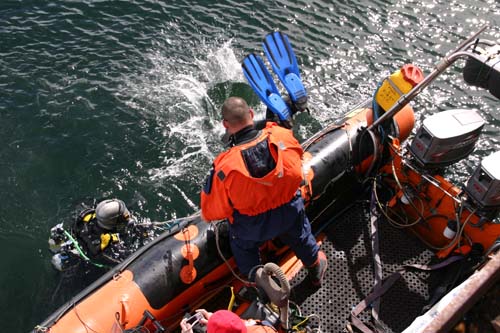
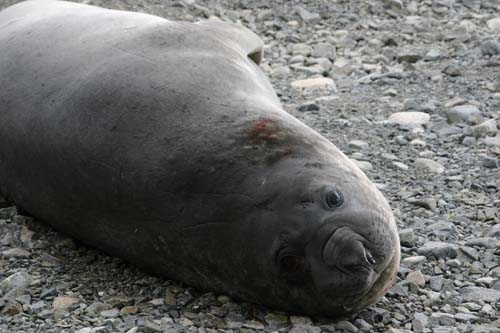
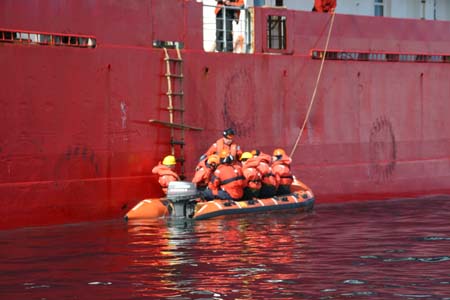
I grab cameras and some warm clothes and head for the boat hut where we don full immersion suits and life jackets - both a struggle to put on in a hurry. then we climb down into the inflatable boat and 4 of us are off at speed across the bay, dodging bergs - referred to as growlers, as that is what it sounds like if you hit even a small piece of ice. We land next to a bay packed with 30 or so elephant seals, who grunt and snort, but otherwise ignore us. Tim and I land and we head up the hill with white plastic tubs, to his fresh water ponds where he hopes to replenish his supply of shrimps.

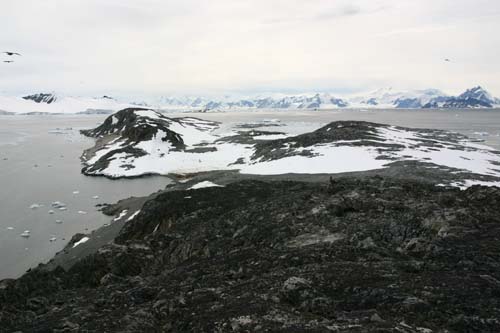
Unfortunately the ponds are situated on the rocky spine of the island where several hundred pairs of Skuas are nesting. For the first hour the Skuas content themselves with half hearted attempts to dive bomb us. Tim collects Shrimps, I make a rock cairn, which I photograph and dismantle. The Skuas watch and cackle. They are very large birds with a long hooked beak.

THURSDAY 28TH. ORCHAS IN THE BAY


I spend the morning in the lab, looking at what the marine Biologists are working on. All the science here is giving us a clearer picture of climate change and its effects. The Marine ecosystem of the Antarctic is highly specialised - adapted to the low temperatures of the sea. all the organisms found here under water are highly susceptible to changes in temperature in the sea water. a rise of one or two degrees and most will perish

There is a minute form of freshwater shrimp found in the melt pools of the islands near here, it is thought that they got there on the feet of birds. Like desert organisms which can be revived when water appears, these shrimps, appear again each year after the ice melts. Scientist are trying to determine just how they do this.


The wind has changed direction and at last the pack ice is being blown out of the bay, so diving and boat travel can begin. We gather on the peer to scout for Orcas or Leopard seals, which would make diving very dangerous, and when the all clear is given I watch Jim doing his first practice dive off the peer. Later after lunch a pod of 7 Orcas are spotted in the bay, which puts paid to more diving, but the boats get within 30 metres of them. By this time I am walking around the point, making ice cairns, and an Orca surfaces 100 metres from the shore.


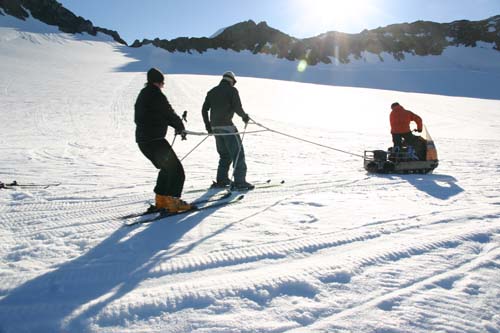
Skiing after dinner at 10.00 pm.

Tuesday, December 26, 2006

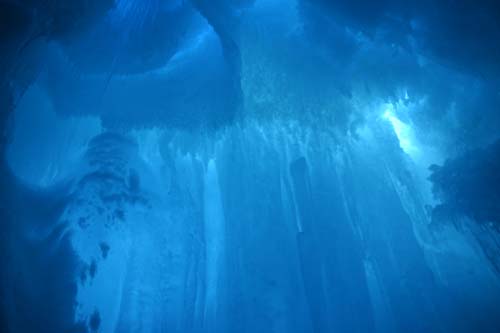
SANTAS GROTTO AND AN ELEPHANT SEAL


We live here in an oil heated cocoon where we can only engage with the astonishing beauty of our surroundings with a lot of expensive back up. So although the Antarctic is all around us it seems you can never quite touch it. That is why until recently man has never lived here, because you cannot live in such harsh surroundings without an industrial backup. There have been some, like Shackleton who have been forced to survive off the land for a year but they were lucky to survive so long.

For me the highlight of Christmas was 'the Queens Speech', delivered by our French chef Cyril, bedecked in a string of false pearls and delivered in a strong French accent which ever so subtly mocked this long standing British tradition!

Friday, December 22, 2006

Summer Solstice


21st December


The moment the weather cleared, 22nd December
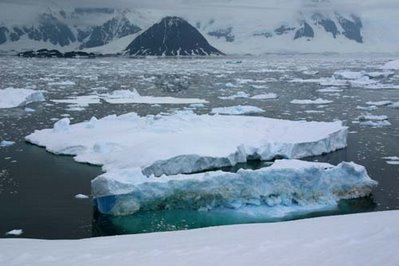


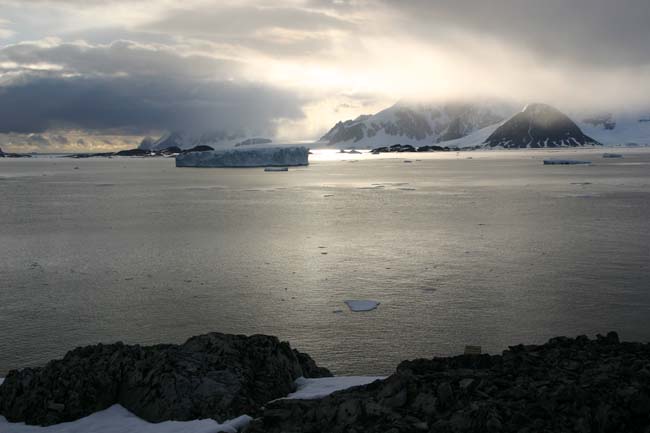
As the sun circles the sky and there is little differentiation between night and day, time becomes cyclical. Today is the longest day, which means that the sun, at this time of the year, will be at its highest point in the sky at midnight. I am interested in this circular time; it changes body rhythms and have decided to make two films of the triangular black Mountain across the bay, and the big tabular berg over the 24 hours of the Solstice.

In practice I chose a site near the south point which has 180 degree views. The berg is on the move North, and I have no idea how far it will move in 24 hours. By the following morning it will in fact have moved about two miles away.

I will have to film each view for two and a half minutes every hour. I have two tripods set up and two 60 minute cassettes for the camera which I change each time I move to the other tripod. I keep a spare battery in my pocket to keep it warm and extend its life. This wont be a time lapse as it has to be done by hand in the open and the berg is not static.

I trudge up the hill, 20 or so times, sometimes staying up for two or three hours. At the most I get 35 minutes to grab a cup of tea and a rest before I set out again; a wearing process. There is no wind and the cloud is dense, sometimes black, and at times almost down to the waterline. Mountains fade into the gloom, and the berg as it moves North, is often hardly distinguishable.

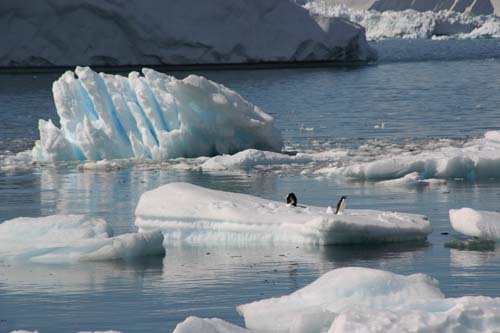
It is however utterly peaceful. Wilson's Petrels quarter the sky, and the tern colony below keeps up a constant racket. There are a pair of bonxies who keep me company throughout the night. The water has warmed considerably so the bergs are melting and no longer grate on the sea bed. There is only the sound of constantly moving ice mush, the screech of terns and the sharp crack of splitting bergs, interspersed with the distant raw of avalanches on the peninsular. As midnight approaches the gloom intensifies, accentuating the extraordinary blues and turquoise in the old ice of the bergs. I pass two Adelie penguins fast asleep on the snow.

For 23 hours the landscape is grey and white. A soft, whispering silence pervades everything. Around 8.00 am the sky begins to clear and, in the last 5 minutes of each cassette, in the last of the 24 hours, the sun touches and illuminates both mountain and iceberg.

Tuesday, December 19, 2006

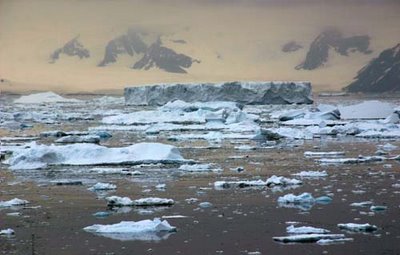
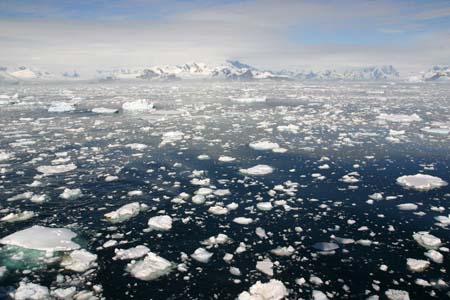
Ice in the bay


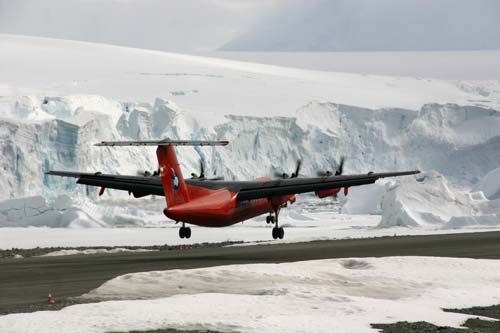
This morning all our friends from the JCR science cruise are headed home for Christmas on the newly restored Dash 7.

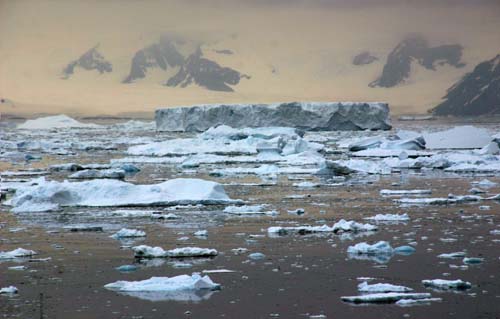
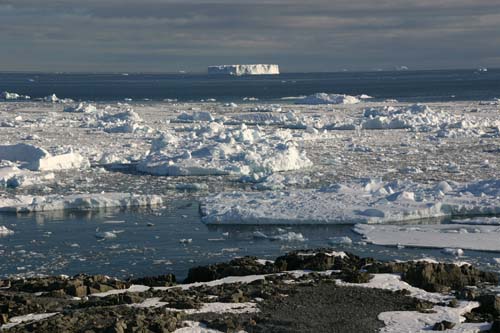
The light here changes all the time as the sun circles the sky in a dipping ellipse, and as storm clouds gather over the mountains. When we first got here there was a big tabular berg in the South bay where it had been grounded all winter. As the day wore on it began to move slowly out to sea. On Sunday it was on the horizon, barely visible. On Monday it had gone.
Today Tuesday, the wind has changed direction and it is heading back to us, gleaming in the evening sunlight.
It has always been my intention to film a day in the life of an iceberg, following a berg in all it's subtle changes in colour and visibility. From white sky to black, faintly ethereal to gleaming white. It looks like I will have to follow it in space as well as time.

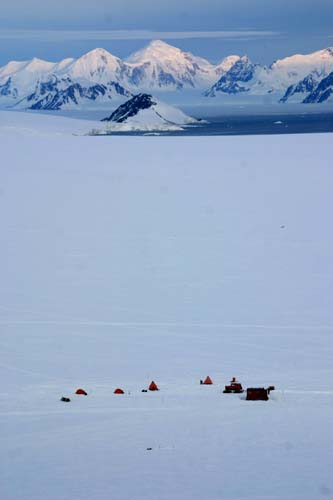
camping out and training on ice


Saturday, December 16, 2006

Saturday 16th, On the glacier above the base


On the glacier above the base

FRIDAY 15TH JCR DOCKS AT ROTHERA


A Berg in the South bay
Approaching the landing
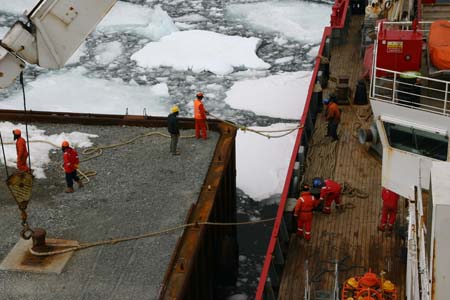
Docking
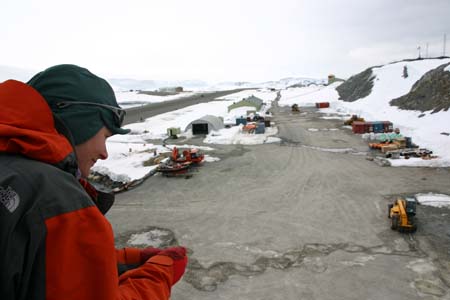
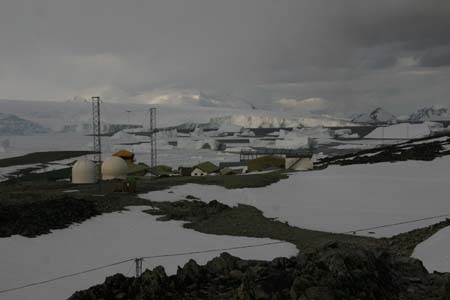
Our home for the next 6 weeks

Thursday, December 14, 2006

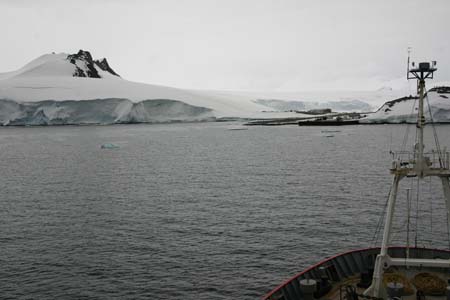
Thursday 14th into Vanadsky and on through loose pack


Thursday 14th, Through the Neumayer Chanel


WEDNESDAY 13TH Annes Birthday - Coctails on the monkey deck


Wednesday, December 13, 2006

KING GEORGE ISLAND Wednesday 13th


Cape petrels and gentoo penguins in the water.

Tuesday, December 12, 2006

Elephant Island


22.00 hrs 12th December. It has been snowing all evening. Elephant Island looms out of the dusk. This is the sight which greeted Shackleton as he and his crew headed for the nearest land in 3 open boats. His crew over-wintered here under an upturned boat while Shackleton and two crew made for South Georgia in the James Caird. This is summer.
Sunday, December 10, 2006

DRAKES PASSAGE


The JCR is entering the convergence between The warm South Atlantic current and The cold Circumpolar current, creating on the convergence line the circumstance for a rich area of Krill, which is the lynchpin of the food chain, with whales at the top.
Scientists are sampling the ocean for temperature, salinity and fluorescence. The water is around 4500 meters deep here and I attach a polystyrene cup to the sink line.

Friday, December 08, 2006

BLACK- BROWED ALABATROSS


Most of the time we see the world in relation to the time of our own life span. Darwin had glimpses of whole other time spans – eons of time. If we were able to speed up 600,000 years (about how long Antarctica has been covered in ice) into 60 seconds a whole new and revealing pattern would emerge. If we could speed up 10,000 years into 10 seconds we would be able to see change happening like a river flowing.
In effect science is about looking for patterns which reveal a process.

This turns out to be very apt as on the Falklands there are things called Stone Runs which are rivers of boulders which flow down the hillsides in wave patterns. Apparently the latest theory is that during the last ice age when the ground was under permafrost, the continuous thawing and freezing of the ground, broke up the rocks into small pieces and over time the big rocks were pushed to the surface in the same way that big nuts come to the surface of a muesli bag. Then over time the big rocks begin to flow millimetre by millimetre down the hill over the rolling shattered small rocks and the flow of these rocks is like rivers or wave patterns on a beach, but created over a few thousand years.

So I wonder here about time. The time scale of events. I had thought to make some kind of an intervention into these stone runs, but the fact of their time is crucial to their pattern and beauty. The permafrost has gone now and the runs are for now static, so I think they are best left as they are, a temporary pause in these rivers of stone.

In art pattern is seen as an aesthetic thing, but this need not be so. A scientist may describe a pattern in terms of maths or equations, or a graph; all forms of language which can be further pinned down by the language of names and labels.
An artist may reveal a pattern in a totally visual way so that you experience pattern as a primary emotion which connects you to other patterns and processes. If you are not tempted to turn that back into language, then something wholly new is made visible. If science and art may run side by side, without trying to do the same thing, then I think a deeper experience of the world is brought into being. Perhaps an image of a stone run made over the last 18,000 years could be linked to an image of moving ice made over 60,000 years, or maybe, just a season.

Wednesday, December 06, 2006

KING PENGUINS


PENGUINS ON THE FALKLANDS


MEGALLANICS AND GENTOOS

THE JOURNEY DOWN


The Torres Straits, Punta Arenas
Flying over the Falklands
The JCR

HEATHROW - MADRID - SANTIAGO - DOWN THE SPINE OF THE ANDES - OVER THE PATAGONIAN ICE FIELDS AND THE TORRES DE PAINE - INTO PUNTA ARENAS - 0N TO THE FALKLANDS TO JOIN THE JAMES CLARK ROSS IN STANLEY FOR THE JOURNEY SOUTH ON THURSDAY 7TH DECEMBER.

Blog Archive

About Me